Orthopaedics deals with bones, joints, ligaments, tendons and muscles. On this site the focus is planned joint surgery, mainly knee and hip replacement, and the many non-surgical treatments that usually come first. Joint pain has a long list of causes, from strains and tendon problems to arthritis and infection, so working out which one is present matters more than choosing an implant or technique.2
In short
For osteoarthritis, the NHS describes exercise as one of the most important treatments, alongside keeping to a healthy weight, pain relief and supportive therapies.1 Surgery such as joint replacement is generally considered when other treatments have not been effective or daily life is seriously affected.15 A replacement can relieve pain but brings its own risks, including stiffness, ongoing pain and blood clots.4 NICE expects osteoarthritis to be diagnosed clinically, without imaging, in adults aged 45 or over with activity-related joint pain and morning stiffness lasting no more than 30 minutes, so the first stop is usually a GP or physiotherapist rather than a scan or a surgeon.6
What this field covers
- Knee surgery: total and partial knee replacement, and joint-preserving operations such as osteotomy (reshaping the shin bone to shift load away from the worn part of the knee).3
- Hip surgery: hip replacement and hip resurfacing.
- Other joints: shoulder replacement and related procedures.
- Non-surgical care: exercise and physiotherapy, weight management, pain relief, walking aids and injections.13
- Preparation and rehabilitation: exercise before surgery and recovery afterwards.
Start with the cause
| Concern or symptom | Possible causes | Usual first step / type of specialist |
|---|---|---|
| Pain and stiffness in both knees, mild swelling, in an older adult | Osteoarthritis is common, but not the only possibility2 | GP or physiotherapist; orthopaedic referral if treatment does not help |
| Knee that gives way or will not straighten after an injury | Torn ligament, tendon or meniscus, or cartilage damage2 | GP or urgent care; sports medicine or orthopaedic assessment |
| Pain after running, jumping or overuse | Sprains, strains or tendonitis2 | Self-care and physiotherapy |
| Hot, red joint with sudden severe pain | Gout or septic arthritis (joint infection); bursitis is another cause of a warm, red knee2 | Same-day medical advice |
| Hip pain and stiffness limiting daily life | Osteoarthritis, rheumatoid arthritis (where the immune system damages joints), or damage after a fall or injury5 | GP, then orthopaedic or rheumatology assessment |
Main types of option
| Option | What it can do | What it cannot do |
|---|---|---|
| Exercise, physiotherapy and weight management | Exercise is one of the most important treatments for osteoarthritis; losing excess weight reduces strain on the knee13 | Cannot rebuild a severely worn joint |
| Pain relief, aids and supportive therapies | Medicines, gels, walking aids, insoles and hot or cold packs can make everyday activities easier13 | Treat symptoms rather than the joint damage itself |
| Steroid injections | May be offered for pain and swelling when other treatments have not worked13 | Do not stop the condition progressing |
| Joint-preserving surgery | Options such as osteotomy or procedures to help new cartilage grow3 | Are not suitable for everyone3 |
| Joint replacement | Replaces a damaged hip or knee joint when pain and stiffness have a big effect on life5 | Some people have ongoing pain, stiffness or instability; infection or a clot may occur4 |
| Deciding against surgery | Legitimate at any stage; non-surgical care continues | Does not reverse joint damage |
What cannot be decided online
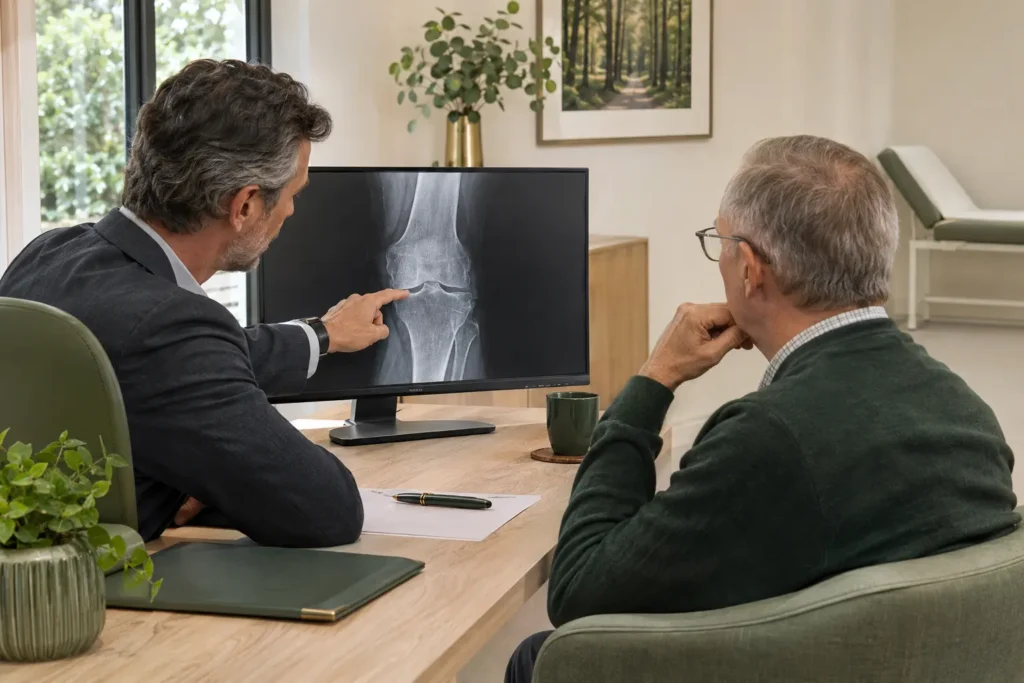
Whether a painful joint needs surgery depends on examination of movement, stability, alignment and muscle strength, with imaging or blood tests added when the picture is unusual or another cause is suspected.6 X-rays are part of planning any operation. The choice between a partial and a total knee replacement, or between different hip operations, depends on which parts of the joint are damaged, bone quality, other health conditions and activity goals.
Before a replacement, the assessment also covers anaesthetic fitness and clot risk,4 and where physiotherapy will continue afterwards, because a new joint is rehabilitated through weeks of exercise rather than simply fitted.
When to seek urgent medical help
For knee pain, the NHS advises getting urgent advice from NHS 111 if the knee is very painful, cannot move or take weight, is badly swollen or has changed shape, locks or gives way, or if a very high temperature comes with redness or heat around the knee, which can be a sign of infection.2
After a knee replacement, call 999 or go to A&E if leg pain and swelling come with difficulty breathing or chest pain. Throbbing or cramping leg pain, a high temperature, pus from the wound, or worsening redness, swelling or pain in the knee need an urgent GP appointment or NHS 111.4
Guides in this section
Related guides elsewhere: blood clot risk when travelling after surgery and aftercare after treatment abroad.
Common questions
- Does Keyhole Knee Surgery Help Osteoarthritis?
- Do Knee Injections Help Osteoarthritis?
- Does Exercise Before Joint Replacement Help?
- Partial vs Total Knee Replacement: What Is the Difference?
- Is Robotic Knee Replacement Better?
- What Is the Recovery Timeline After Knee Replacement?
- How Long Do Knee and Hip Replacements Last?
- Anterior vs Posterior Hip Replacement: Does the Approach Matter?
- What Precautions Are Needed After Hip Replacement?
- What Is Hip Resurfacing?
- What Does Shoulder Replacement Involve?
- What Is the Risk of Blood Clots When Flying After Surgery?
Sources
- NHS. Osteoarthritis: treatment. NHS website. https://www.nhs.uk/conditions/osteoarthritis/treatment/. Accessed 5 November 2026.
- NHS. Knee pain. NHS website. https://www.nhs.uk/symptoms/knee-pain/. Accessed 5 November 2026.
- NHS. Knee replacement: alternatives. NHS website. https://www.nhs.uk/tests-and-treatments/knee-replacement/alternatives/. Accessed 5 November 2026.
- NHS. Knee replacement: complications. NHS website. https://www.nhs.uk/tests-and-treatments/knee-replacement/complications/. Accessed 5 November 2026.
- NHS. Why a hip replacement is done. NHS website. https://www.nhs.uk/tests-and-treatments/hip-replacement/why-a-hip-replacement-is-done/. Accessed 5 November 2026.
- NICE. Osteoarthritis (QS87), quality statement 1: diagnosis. National Institute for Health and Care Excellence. https://www.nice.org.uk/guidance/qs87/chapter/quality-statement-1-diagnosis. Accessed 5 November 2026.