Hair restoration covers the diagnosis and treatment of hair loss: medicines, other medical treatments, hair transplant surgery and cosmetic cover such as wigs. Hair loss has many causes, some temporary and some needing medical treatment, so working out which type you have comes before any decision about surgery.
In short
Effective treatment for hair loss begins with finding the cause, and some people have more than one cause at the same time.6 Inherited pattern hair loss is the most common type2, while loss after illness, stress or weight loss is often temporary and grows back.1 Medicines only work while they are used1, and a transplant moves existing hair rather than stopping inherited loss from progressing.3 The route starts with a GP or dermatologist naming the type of loss; a transplant only makes sense once the pattern, how far it may progress and the donor supply are known.34
What this field covers
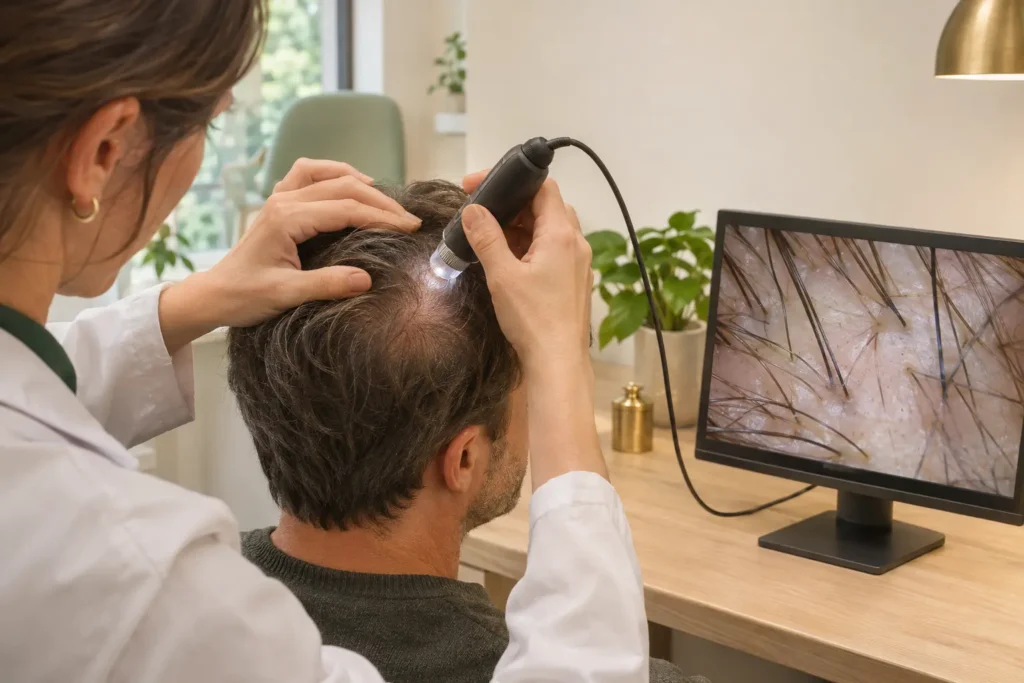
- Diagnosis: history, scalp examination, a hair pull test, and blood tests or a scalp biopsy when a medical cause is suspected.36
- Medicines: minoxidil applied to the scalp and finasteride tablets, the main treatments for male pattern baldness.1
- Other medical treatments: steroid injections or creams, immunotherapy and light treatment for particular types of loss.1
- Hair transplant surgery: moves small bundles of hair, usually from the permanent donor area, to thinning or bald areas.4 The two main ways of harvesting hair are follicular unit extraction (FUE) and follicular unit transplantation (FUT).
- Cosmetic cover: wigs, extensions and styling, for temporary or permanent loss.3
Start with the cause
| Concern or symptom | Possible causes | Usual first step / type of specialist |
|---|---|---|
| Gradual thinning on top or a receding hairline | Inherited male or female pattern hair loss12; hormonal change such as menopause2 | GP or dermatologist to confirm the pattern before medicines or surgery are discussed |
| Sudden shedding all over the scalp | Illness, stress or shock, weight loss, iron deficiency1; pregnancy; thyroid problems; some medicines2 | GP; blood tests may reveal a medical cause3. Much of this hair grows back1 |
| Round or patchy bald spots | Alopecia areata; scalp infection; a hair-pulling disorder2 | GP or dermatologist; steroid injections into patches are one option1 |
| Thinning where hair is pulled tight | Traction alopecia from tight styles or harsh treatments, which may become permanent if scarring develops2 | Changing hair care habits6; dermatologist if loss persists |
| Hair loss after cancer treatment or a major illness | Effects of treatment or illness; hair usually regrows26 | The treating team or GP; cover with wigs while waiting1 |
Main types of option
| Option | What it can do | What it cannot do |
|---|---|---|
| No treatment or waiting | Appropriate for many temporary types of loss, which grow back without treatment1 | Reverse inherited pattern loss |
| Wigs and cosmetic cover | Cover temporary or permanent loss without medical risk3 | Change the underlying hair loss |
| Minoxidil | Help early loss in men and women16; results take about 6 to 12 months6 | Regrow a full head of hair; benefits fade when it is stopped6 |
| Finasteride | Slow male pattern loss and stimulate some regrowth6 | Keep working once stopped1; not for women1 |
| Low-level laser device | Small studies suggest improved hair density in hereditary loss3 | Offer long-term evidence, which is still needed3 |
| Hair transplant | Move hair from the permanent donor area to thinning areas4; most suited to permanent loss on the top of the head3 | Stop inherited loss from progressing; more than one operation may be needed3 |
What cannot be decided online
The type of hair loss is confirmed by examining the scalp, nails and other affected areas, asking how and when the loss started, and sometimes by blood tests, a pull test or a scalp biopsy.36 Photographs cannot show scarring, inflammation or the density of the donor area.
Transplant surgery is intended for people who have been appropriately selected and diagnosed, and the professional society for hair restoration surgeons advises confirming that the doctor will perform the surgery personally rather than delegating it to an unlicensed technician.4 Your age, how far the loss may progress and how much donor hair you have shape whether surgery makes sense, and these are judged in person.
When to seek urgent medical help
- Sudden hair loss, patchy bald areas or noticeably more shedding than usual: see a doctor promptly, because sudden loss can signal a medical condition that needs treatment.2
- After a transplant: redness, heat, soreness or swelling around the treated or donor area, pus, a wound opening, or feeling generally unwell or feverish can mean infection. Contact a doctor straight away.5
Guides in this section
Surgery has its own section: see hair transplant, with FUE and recovery after a hair transplant. Because transplant work is sometimes delegated to technicians,4 see how to check who is qualified to operate.
Common questions
- What Causes Hair Loss, and Why Does Diagnosis Matter?
- Do You Still Need Finasteride or Minoxidil After a Hair Transplant?
- Is a Hair Transplant Permanent?
- Can You Be Too Young for a Hair Transplant?
- Can Women Have Hair Transplants?
- How Many Grafts Does a Hair Transplant Need?
- FUE vs FUT: What Is the Difference?
- FUE vs DHI: Is DHI a Different Operation?
- Does a Hair Transplant Hurt?
- When Will Hair Transplant Results Show?
- What Is Shock Loss After a Hair Transplant?
- What Should You Know About Beard Transplants?
Sources
- NHS. Hair loss. NHS website; reviewed 2024. https://www.nhs.uk/symptoms/hair-loss/. Accessed 5 November 2026.
- Mayo Clinic Staff. Hair loss: symptoms and causes. Mayo Clinic; n.d. https://www.mayoclinic.org/diseases-conditions/hair-loss/symptoms-causes/syc-20372926. Accessed 5 November 2026.
- Mayo Clinic Staff. Hair loss: diagnosis and treatment. Mayo Clinic; n.d. https://www.mayoclinic.org/diseases-conditions/hair-loss/diagnosis-treatment/drc-20372932. Accessed 5 November 2026.
- International Society of Hair Restoration Surgery. Surgical treatments. ISHRS; n.d. https://ishrs.org/patients/treatments-for-hair-loss/surgical-treatments/. Accessed 5 November 2026.
- Guy’s and St Thomas’ NHS Foundation Trust. Surgical wounds and preventing infections. Guy’s and St Thomas’; n.d. https://guysandstthomas.nhs.uk/health-information/surgical-wounds-and-preventing-infections. Accessed 5 November 2026.
- American Academy of Dermatology. Hair loss: diagnosis and treatment. AAD; n.d. https://www.aad.org/public/diseases/hair-loss/treatment/diagnosis-treat. Accessed 5 November 2026.